Thursday, March 26, 2015

Cattle Now Available on Audible, Amazon and Itunes

Hi, gang! The audiobook of my horror novel Cattle has officially gone live on Audible, and will be available on Amazon and iTunes in the next few days. I hope you guys purchase a copy (or get it free with a 30 Day trial of Audible) so that the company, Walker's Words, will continue to adapt my novels to audiobook format.

Next up for Walker's Words: The Oldest Living Vampire Tells All!!!

They plan to do all my vampire books next, so be sure to grab a copy of Cattle and show your support.

Use the link below to visit the sales page on Audible.

http://www.amazon.com/Cattle-The-Fearlanders/dp/B00V90AWQM/ref=sr_1_16?ie=UTF8&qid=1427412177&sr=8-16&keywords=cattle+audiobook


Not interested in audiobooks? Show your support by visiting the page and tagging the item with a few keywords. Tags help amazon promote my work by putting it in front of readers and listeners when they search for specific terms like "zombies" or "horror".

You can also share this blog post with your Facebook friends. Maybe someone you know enjoys balls-to-the-wall zombie horror fiction or zombie books and horror movies.

Monday, February 23, 2015

For My Fellow Writers... A Sight for Sore Eyes

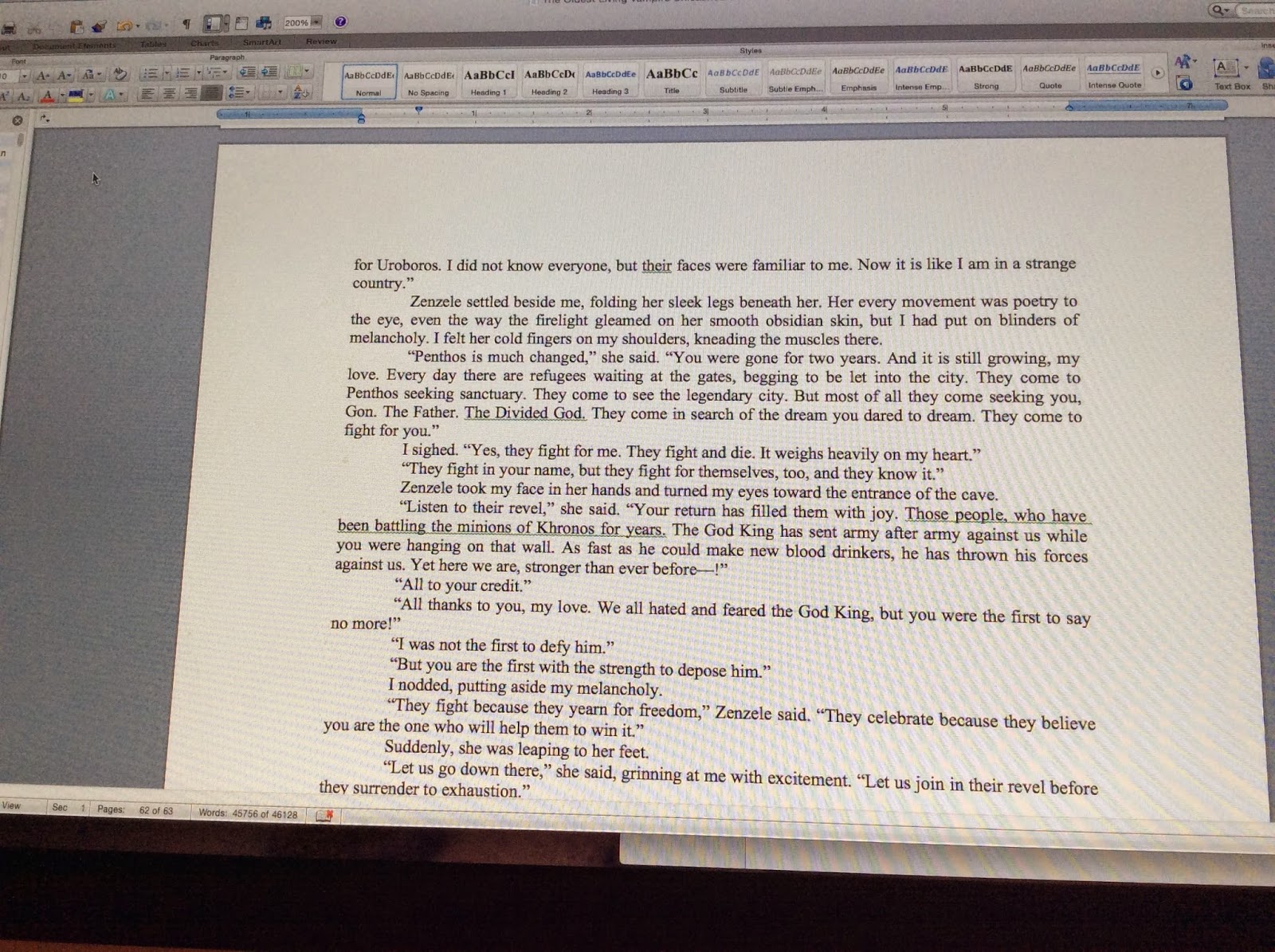
I spend so much time on my computer there are days I think I am going to go blind. One of my problems is Word. That glaring white background for my text can sometimes be more than a little taxing on the eyes. If you are not a writer, imagine staring into a sunny snowbank for eight to twelve hours and you will understand how a writer's eyes feel after a long day of writing or proofreading. I just kind of stumbled across this and was so happy about it I decided to post it for all my other writer friends.

Here are the instructions, and a neat little pointer, on how to make your writing day a little more pleasant.

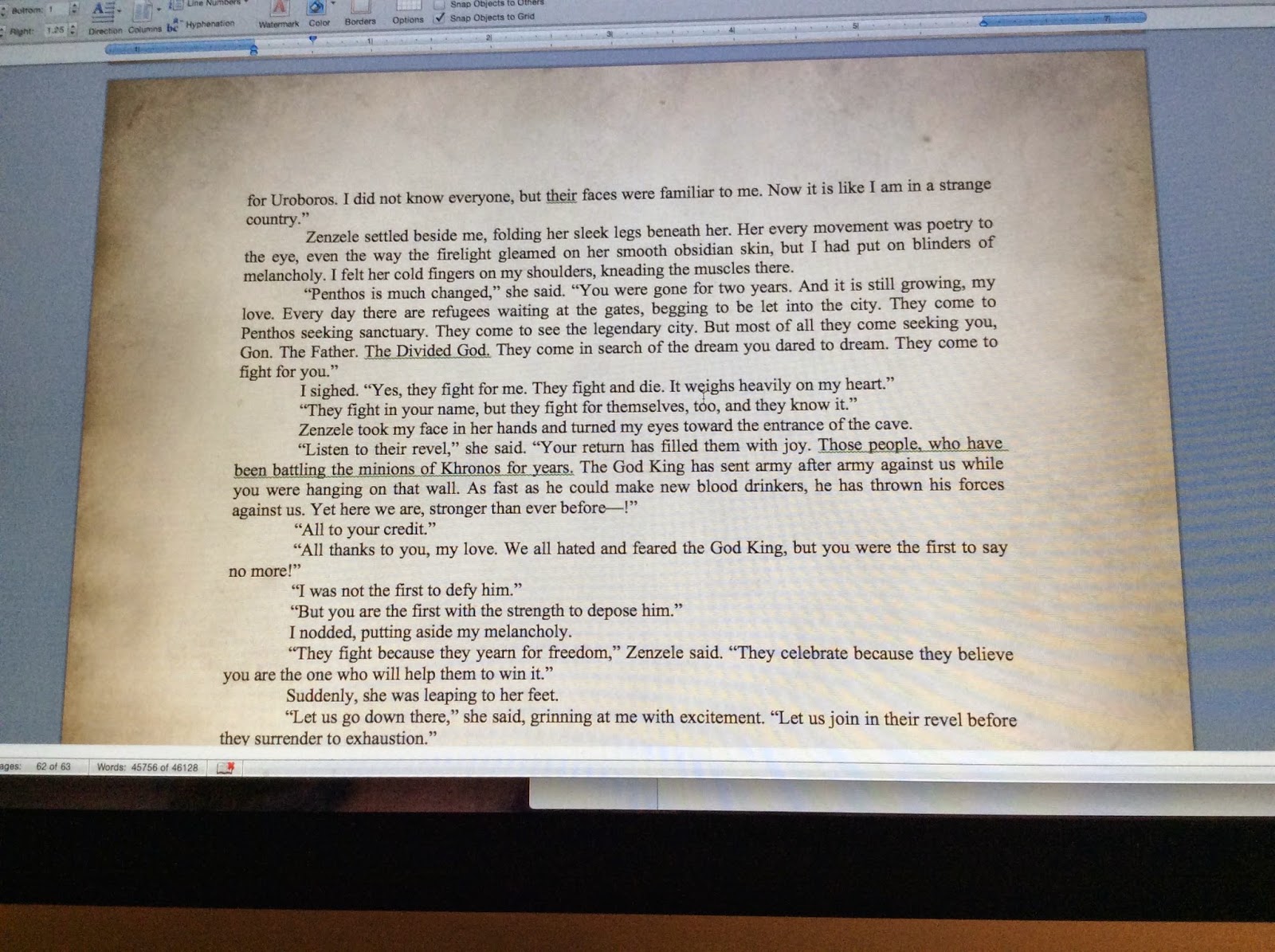
Change the background of your Word document to an "old paper" texture, or whatever kind of texture you find most soothing on your tired, screen glare dazzled eyes.


This is the Dazzler. A glaring white box of LED light that comes standard with Word.

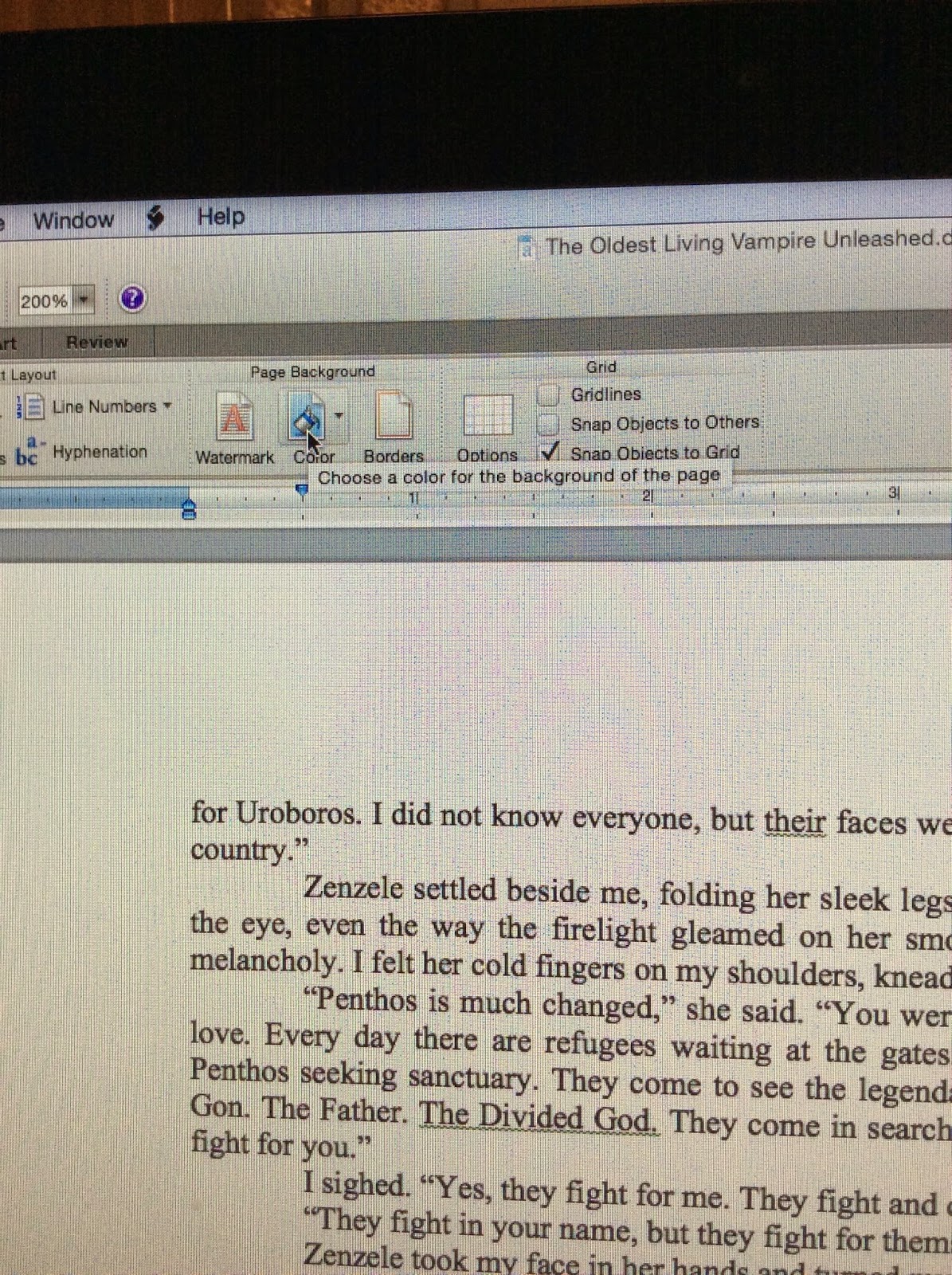
Select LAYOUT in your ribbon.

Slide the cursor over and select COLOR.

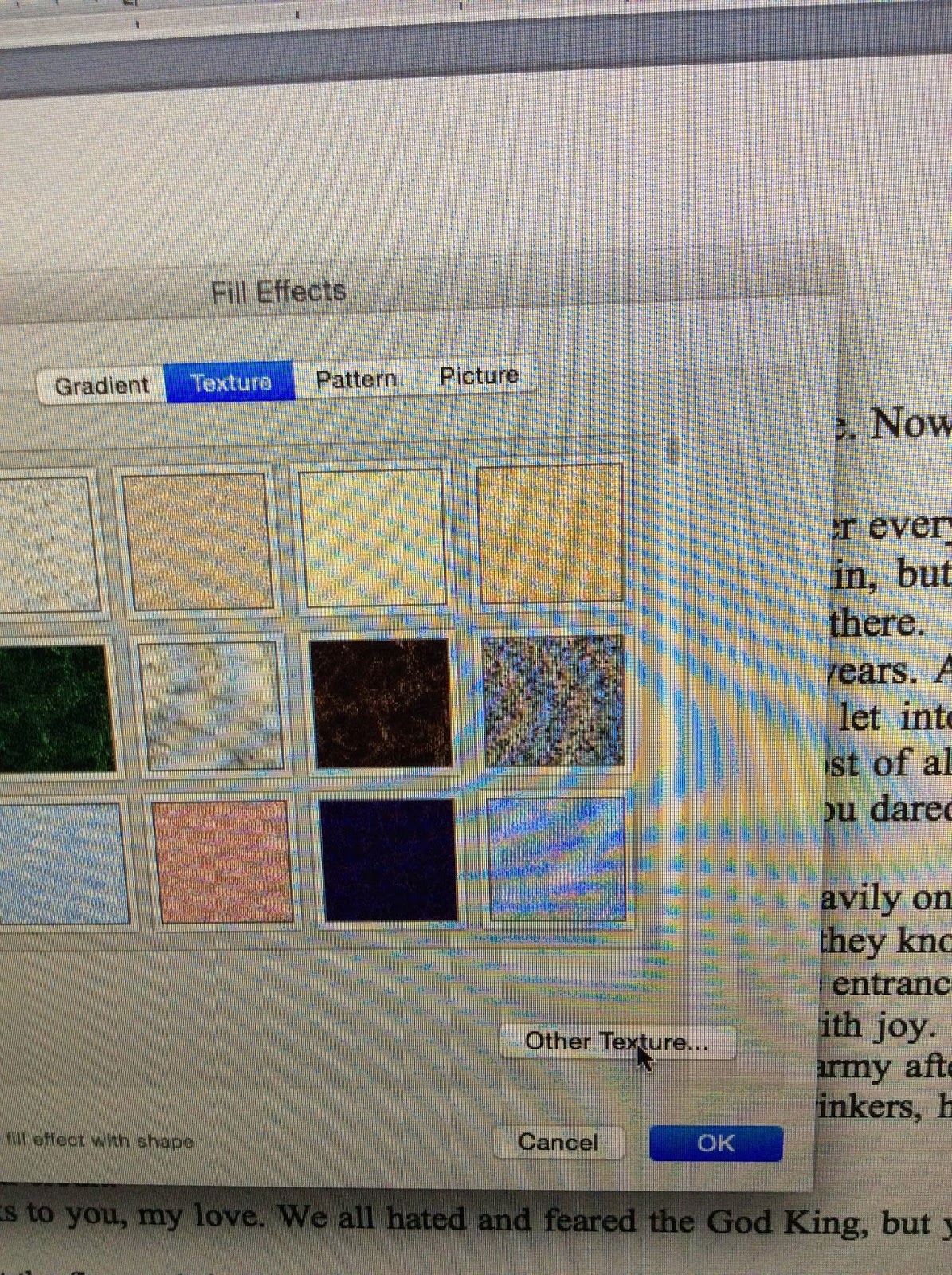
Select FILL EFFECTS.

Select TEXTURE and the OTHER TEXTURE...

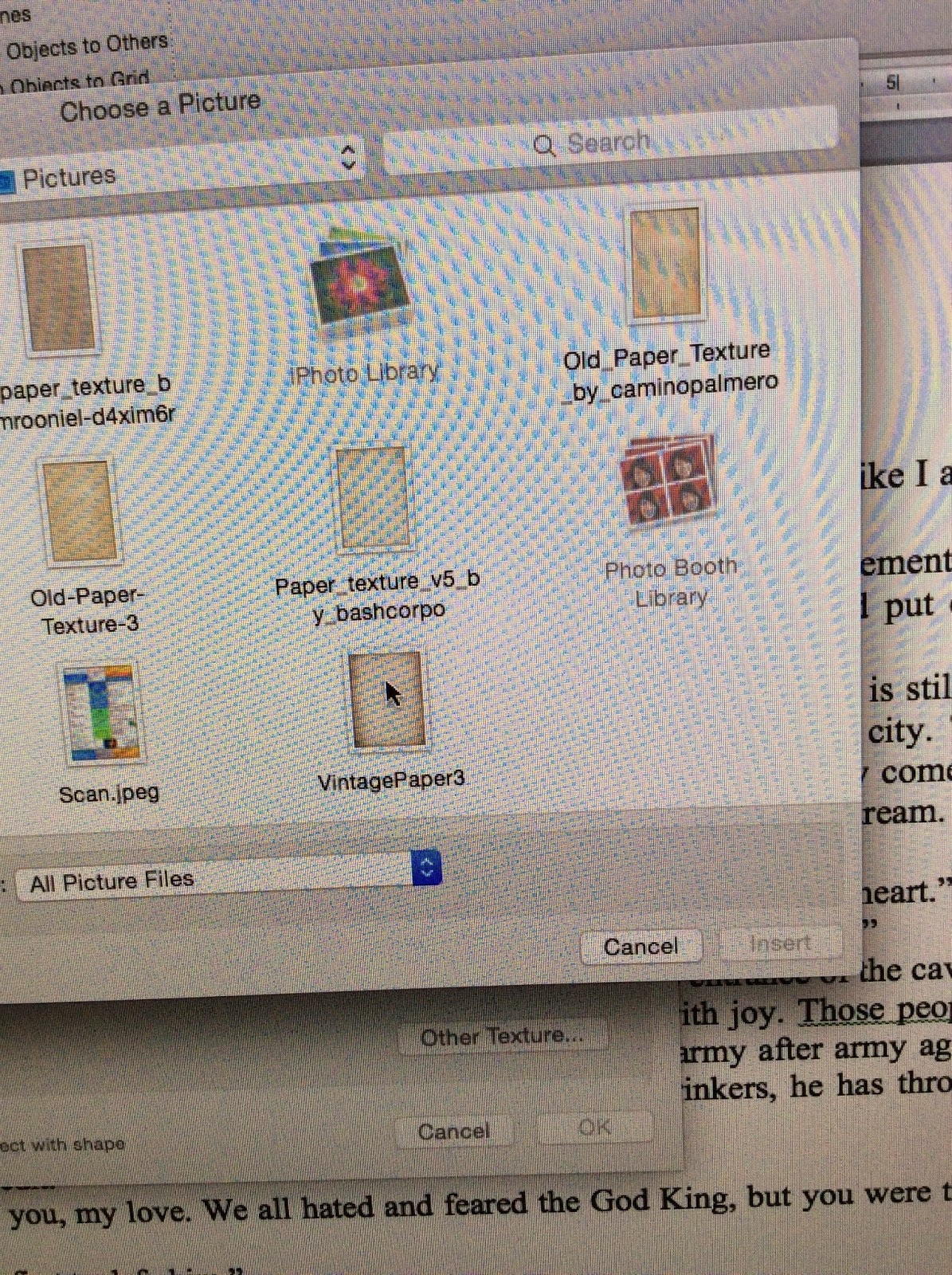
Now select the texture you downloaded off the internet, which I forgot to tell you about earlier. I typed "paper textures" into Google and picked out several textures I liked and saved into my PICTURES folder.

I selected a texture called "vintage paper"... hit OK.

Now your Word background looks like a piece of old paper, much easier on the eyes.

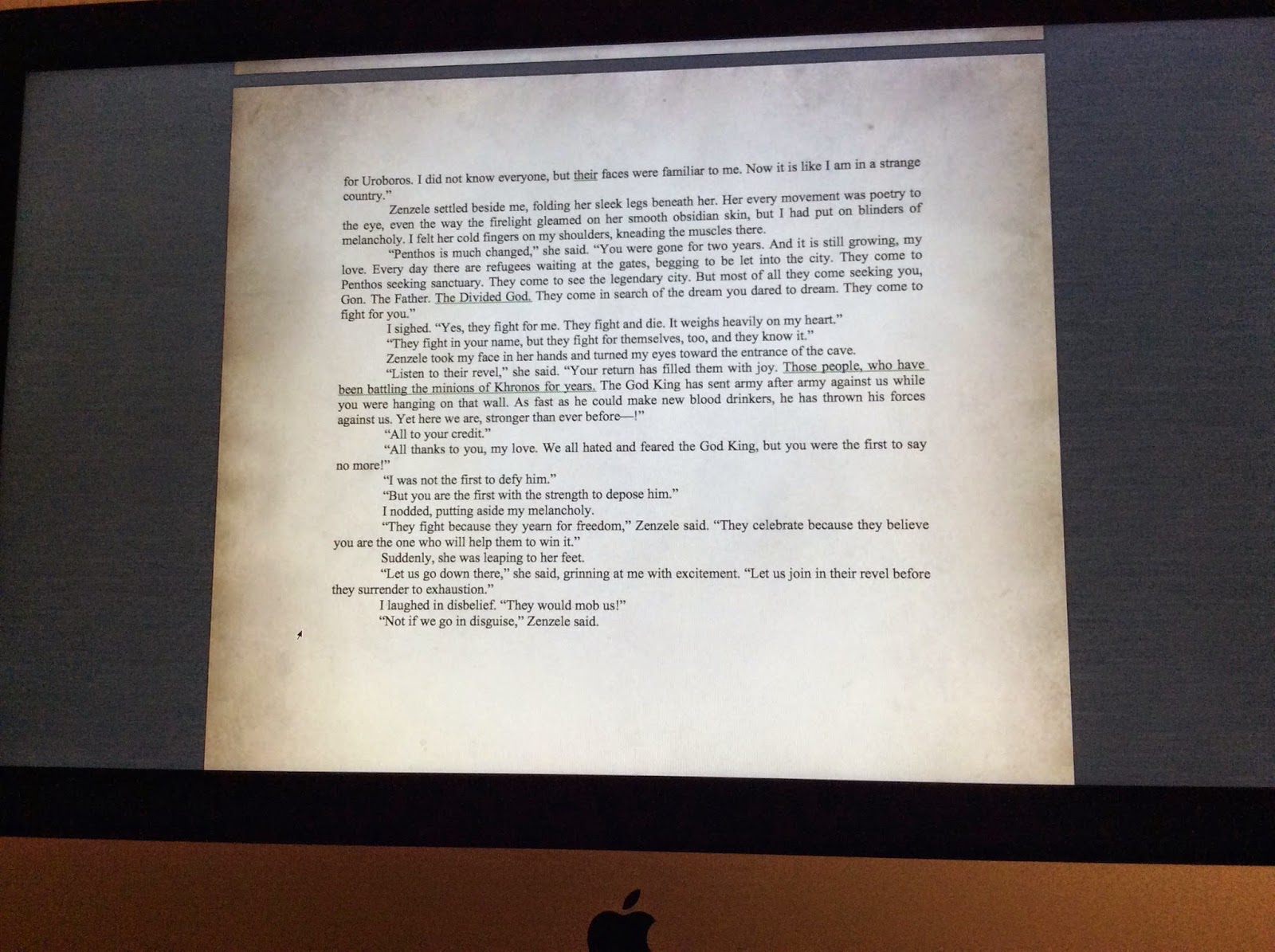
You can also click Focus View and switch to a simplified version of the UI.
The background of Focus View can be changed too. I prefer textures rather than smooth backgrounds, as it seems easier on the eye.

You can also download a program called f.lux which will dim and warm the colors of your monitor depending on the time of day, which will also help with some of the eye fatigue.

Enjoy!


Monday, May 12, 2014

A New Ongoing Serial-- Featuring Gon and Private Eye Dixon Peters!

Just for fun, I thought I might do a mash-up featuring some of my favorite characters, Gon, Dixon Peters, and Doc Wormwood. I don't have a title for this yet. Maybe you can help me come up with one!  


Chapter 1: The Shamus


My name is Dixon Peters -- go ahead, laugh. I’m a private eye, a dick, a gumshoe. Some people call me the supernatural shamus. I’ve even been described as the premier private investigator of the supernatural world. As such, I’ve dealt with my fair share of bogeymen and poltergeists, but if there’s one thing that creeps me out more than anything else in the grimy little corner of the universe I’ve set up shop in, it’s vampires.
For one thing, they’re dead. Cold and dead and slimy, with skin as smooth and hard as marble. Imagine going to some fancy museum and stopping for a moment to admire a Greek statue, and suddenly the eyes in that statue roll over to look at you, and the thing’s face twitches, cheeks plumping up, lips splitting open, revealing a set of very white and very sharp teeth. That’s what it’s like the first time you see a vampire. It’s an affront. It’s the bright candy wrapping of the universe splitting open to reveal a rotten core of squirming maggots.
Their eyes seem to suck up any source of light in the room, glinting at you like lanterns. They move in ways that are inexpressibly inhuman, staying too motionless for too long before blinking forward into a new position, their limbs arranged in ways that are subtly abnormal. Sometimes they forget to breathe, or they talk too loud and make your ears throb in pain, and their laughter… its like fingernails down a chalkboard.
Werewolves I get. Wizards and witches… well, technically I am one. I’ve dealt with enough demons in my day that I don’t even bat an eye. But vampires… ugh! Give me a rampaging Elder God any day of the week.
The vampire I was currently chasing through this dirty alley in the Borough called himself the Marquis. Rumor had it he was the Marquis Donatien Alphonse Francois de Sade, a French aristocrat famed for his libertine philosophies and a whole lot of pornographic writings. Born in 1740. Died in 1814. Still kicking around in Dunsany, Massachusetts in October of 1934, 120 years later.
How he ended up in Dunsany is anybody’s guess, but I’d been hired by a crazy old bastard named Hiram Wormwood to find him, and that’s exactly what I’d done.
Now I just needed to catch him.
Doc Wormwood (that’s what he asked me to call him) believed de Sade had murdered one of his friends, an old lawman from out west named Bill Starr. I had tracked the bloodsucker down to a nightclub called the Scarlet Letter, only the letter on the sign was a big swirly V instead of an A, like in the story by Nathaniel Hawthorne. I just intended to have a look at him, ask him a few questions, see what kind of vibe I got from him, but the creepy ess-oh-bee took off as soon as he laid eyes on me, and it was all I could do to keep up with him as he raced through the backstreets and alleys of my adopted hometown, climbing walls and jumping over moving cars like a kid jumps over mud puddles. A normal human being wouldn’t have a chance of keeping up with the creature, but here’s the thing: I ain’t no normal human being.
Now don’t get me wrong. I ain’t no super-man. In every way but one, I am just a below average specimen of the mammalian species currently claiming proprietorship of this ball of mud and water we call planet Earth. I’m ugly, getting a little soft around the middle, getting a little gray in the whiskers (and just recently, in my Adam’s patch, which is one of the more depressing things I’ve had to deal with recently), and I drink and smoke just a little too much to be running after some critter that don’t seem to have to obey the laws of physics. 
But I’m also an Umbra, which is a subspecies of Homo sapiens that is able to give those aforementioned laws of physics a little nudge.
You call it magic.
Well, there’s one other thing that’s unusual about me – or maybe I should say two other things – but it’s not really pertinent to my current situation.
Up ahead, the Marquis de Sade, dressed in a ridiculously outdated red brocade justaucorps and lace jabot, twisted around to look at me and then leapt onto the wall at the end of the alley.
He leapt straight up, just a little more than two stories in height. Rather than bounce off the bare brick wall, as any normal human being would do, the Marquis clung lizard-like to the wall and scurried rapidly upwards, pedaling his feet in a comical manner.
(I don’t know how vampires stick to walls like they do, whether it’s magic or some strange property of their skin, but it looked like his feet couldn’t hang onto the wall with those jackboots on.)
He went up, up and vanished over the ledge of the roof about five stories above. Took him all of six seconds to make the climb.
Damn it!
I had been using my modest Umbra talents to keep pace with him, speeding myself up just a little faster than normal so that I could move as quickly as the vampire -- basically, compressing my lifespan into a much smaller space of time – but I dispersed the magic spell as soon as I lost sight of my quarry. No sense burning up my allotted span if it wasn’t going to get me any closer to him.
I needed to find out which way he was going.
As I couldn’t climb walls like some sticky-footed gecko, I did the next best thing. I Ghosted.
Astral projection. It’s one of the few Umbra tricks I’m actually good at. Well, that and jinxing the magic of other Umbra like me. I could astral project before I even knew what an Umbra was, though back then I thought they were dreams, or that I was crazy and just imagining all of it. Later, after Magus Grimberg took me under his wing and tried to train me, we found out astral projection was the only thing I had any real aptitude for. I couldn’t summon. I couldn’t teleport. I couldn’t read minds or shape-shift or turn invisible. All I could do was fly, but that was good enough for me. It took away some of the sting of discovering that I was in almost every other way a complete failure as an Umbra.
The instant the Marquis vanished from sight, I skidded to a halt and closed my eyes. Muttering a quick incantation under my breath, I shot up out of my body like a rocket.
The world looks very different in the astral plane. In the astral plane, everything scintillates inside its own little corona of energy.  You call them auras. Human beings, in the astral plane, are bright, sparkling, multi-hued beings, while inanimate objects flicker dimly. You can tell a human’s disposition by the color of his aura, too. Yellow is for happy, pink is love, red is for anger, blue despair. I don’t know if the colors are really there, or if that’s just how my untethered soul perceives its surroundings, but it’s not just handy when you’re trying to catch a suspect, it’s a feast for the soul.
Everything has its own unique pattern of wavering energy, like a person’s fingerprints. Buildings, trees, that rat scrounging in the garbage, the wet clothes hanging on the lines strung across the alley… everything glows.
Everything except vampires.
Vampires are like black holes, the theoretical sinkholes in the skin of the universe. Not only do they not emit any light, they seem to draw in the energy of everything around them, sucking it in like animated sponges. They drink the light like they drink human blood.
The encircling buildings fell rapidly around me. I flew up, free of gravity’s shackles, invisible, relishing the sensation of flight, as I have always relished it. Turning slowly in the air, I cast about for the bloodsucker, saw the creature racing quickly in the other direction, a churning shadow. He had jumped to the roof of the adjacent building, was trying to double back.
Amateur!
And then he started climbing down… behind my paralyzed body!
About five minutes too late, I realized the Marquis wasn’t trying to run away from me. He had led me into a trap!
Typical vampire hunting strategy: lead your victim to a secluded area, somewhere you can dispatch them without threat of discovery, feed on them, then dispose of the body. People go missing all the time. It’s vampires.
I fell as quickly as I had risen, dropping into my body like a big rock chucked into a bucket. My knees buckled and I farted. Disoriented, I tried desperately to reconnect with my nerve endings in time to cast a protective spell. I stumbled around like a drunk, bringing my hands up defensively, but the vampire was on me before I could uncross my eyes.
He tackled me hard, drove me into a nearby dumpster. Garbage spilled around us as we slid across the ground.
“Why do you pursue me, Umbra fool?” he hissed, his fingers digging into the muscles of my shoulders.
His cold breath smelled like copper and spoiled meat. His eyes were black pits rimmed in vermillion. De Sade was 74 years old when he died, but he looked 174. Face sagging like unbaked dough. Talcum clumped in the wrinkles of his flesh. He had rouged his cheeks, lined his eyes in black and his lips in red, but it just made him look like a clown. An old, ugly, perverse clown.
“I need… to ask you… some questions,” I gasped, turning my face from that horrid breath.
“Questions?” the vampire cried, and he laughed incredulously. He said something quickly in French, probably some scornful declaration of disbelief, then pressed his face close to mine once more. “You forfeit your life to ask me some questions?”
“Why did you kill Bill Starr?” I spat.
“Bill Starr is dead?” the Marquis said, pushing away from me in surprise. His red-rimmed eyes narrowed. His wormy lips curled back from his fangs. “I would like to believe you are lying, but I can smell that you are not. How did Bill Starr die, and why do you think I killed him?”
“I don’t believe it, my client does,” I said. I wriggled beneath the creature, trying to push myself out from under him with my elbows. A banana peel fell across my face and I batted it away.
“And who is that?” the Marquis asked. He felt me twisting beneath him and grinned. He arched an eyebrow and began to subtly grind his ass against my groin.
“Stop that!” I snarled, and he tittered, chin to his chest, a bony finger pressed to his lips.
“Pardon! You Americans are so repressed! But who hired you to find me? Who believes I killed Bill Starr?” he asked.
“His friend. Hiram Wormwood.”
“Senility,” de Sade said dismissively. “The mortal is almost as old as I!”
“So you deny it?”
“Of course I do. I was quite enchanted by the giant American. So tall and rugged. So… virtuous. I even offered to give him the Strix. I offered him immortality in exchange for a single night of passion, but he refused. I was disappointed, of course, but not enough to harm him. I would never harm him. Not willingly. Not unless he asked me to.”
“Any idea who might have wanted him dead?” I asked.
The Marquis grinned insouciantly. “Perhaps…”
“Who?”
He started to answer.
Before he bent his tongue to the name, the smelly French vampire twisted violently around. He looked to the mouth of the alley and cursed under his breath. “Merde!” An instant later, he vanished. The speed of his departure rippled my clothes, sent the garbage around me flapping in breezy loop-de-loops.
A man in sleek black modern clothes stepped into the alley. He had long, slightly curly auburn hair and a light beard, pale skin and glinting hazel eyes.
Another vampire!
Clambering to my feet, I reached into my pocket and retrieved the gadget the Doc had given me. I hadn’t been able to use it on the Marquis, but I wasn’t giving this bloodsucker a chance to get the drop on me.
“Stop right there!” I shouted, pulling the gizmo from my pocket and aiming it at the thing. I tried to cock it like the Doc had shown me. The mechanism was stubborn, hadn’t been used in a long time. Finally, with a metallic snap, two fins popped out of the sides of the device, armed with little silver darts. “The poison in these darts can, uh, decouple the molecular bonds of the symbiote that resides within you.”
I frowned. I was pretty sure that’s what the Doc had said it would do. Something like that anyway.
The vampire eyed my weapon with great interest. His nostrils flared and then he dismissed it. His glinting green eyes flicked up to mine.
“Be at ease, mortal. I mean you no harm,” the vampire said. His voice was deep and mellifluous, with just the faintest hint of a European accent. “We have a common enemy, you and I, though I do not believe you know who that enemy truly is. Not yet anyway.”
“And you are?” I asked, lowering the Doc’s gizmo.

The creature smiled faintly and bowed at the waist. “I am Gon, the world’s oldest living vampire.”


Let me know what you think about it so far!

Wednesday, March 26, 2014

New short story "Grethel" available on the Kindle Store.


Everyone knows the story of Hansel and Grethel, but what happened after the happily ever after? Joseph Duncan, author of The Oldest Living Vampire Saga, expands upon the fairy tale originally recorded and published by the Brothers Grimm in 1812. Grethel, a grown woman now, is haunted by her ordeal in the witch's cottage. The old crone who held her captive when she was a child is long dead, but the witch's spirit calls out to Grethel in her dreams. It is a siren's call that Grethel finds both terrifying and alluring, and when a handsome young nobleman seduces the woodcutter's daughter, Grethel finds herself torn between her desire for love and her thirst for the old crone's arcane knowledge. 

"Happily ever after" can have very different meanings, some sweet and hopeful... and some quite dark and frightful. Grethel is a fairy tale for adults, a grim fable about the seductive power of love and the allure of evil.


Thursday, March 13, 2014

Lair of the Luciferians is OUT!

Get your copy today!

The Two-Fisted Private Dick is Back 

It's been two years since private investigator Dixon Peters saved the world from the Elder God Hellmouth. He's got a fancy new office uptown, a cute new secretary and more work than he can shake a stick at. So when millionaire industrialist Franklin G. Bumgarden III asks him to find his runaway children, Dix almost turns down the case. But Dix can't resist a puzzle, and the mystery of the missing Bumgarden kids looks like a real doozy. Within 24 hours of accepting the assignment, Dix finds himself knee-deep in ensorcelled housewives, lycanthropic assassins and demonic spies. In fact, everyone seems to know who he is and what he's looking for. 

A Change of Face 

The only way he's going to solve this mystery, Dix quickly realizes, is to go undercover. Deep undercover. Lucky thing his best friend Ratty is a shape-shifter! With new faces and fake identities, Dix and his secretary-cum-girlfriend set off to find the Bumgarden kids... and just maybe, he hopes, unravel the mystery of the enigmatic Luciferians before something really bad happens! 

Lair of the Luciferians is an action-packed detective novel, a tongue-in-cheek homage to the hard boiled tales of Raymond Chandler and Dashiell Hammett, featuring one of the most unique private dicks ever created, the supernatural shamus Dixon Peters.

Reader raves for Menace of Club Mephistopheles: "An absolutely enjoyable read... for anyone who enjoys supernatural mysteries, or just plain weird fiction, I recommend giving it a try."... "An interesting mix of myth, magic and gumshoe detective. Starts right into the action and never lets up."... "I had been dragging my feet on buying this book because of the genre... not usually my type of story... what a mistake!"... "Not one for detective novels, I fell into this read as easy as watching Bogart and Bacall dance around a scene. Has tongue-in-cheek humor, sex (twisted), violence, and a taste of Mike Hammer... all blended into a H.P. Lovecraft nightmare - a nightmare complete with Apocalyptic visions and dramatic solutions."... "Very interesting take on the whole private eye genre. Loved the 1920's setting with the hard boiled PI and his slimy cohorts. Great stuff. Throw in a little HP Lovecraft for good measure, maybe spice it up with some magic and bam....instant fun."


Get Lair of the Luciferians for Kindle!

Tuesday, March 4, 2014

Coming Soon! Lair of the Luciferians

Just a note to inform fans of my private detective Dixon Peters, the new novel, Lair of the Luciferians, is almost finished and will be available in paperback and for the Kindle ereader very soon.

I tried to make this one much more of a mystery than the original, with a lot of crazy plot twists and double crosses, and of course, demons, magic and rampaging elder gods.

In Lair of the Luciferians, private eye Dixon Peters is hired by millionaire industrialist Franklin Bumgarden to find his missing children. Their father suspects the kids have been seduced by an Umbra film-flam artist named Ahura Mazda. Dix quickly begins to think there is a lot more going on than a simple missing persons case when he is attacked by a lycanthropic assassin who demands to know if Dix is working for a cult called the Luciferians. And to further complicate matters, Peters' arch enemy, Romeo Swansea, is up to his usual hijinks. Is he just looking for revenge, or is Swansea somehow involved in the disappearance of the Bumgarden kids?

I should have the final draft finished in about two weeks, so long as everything goes smoothly. I'll update this post when it is available for purchase.

Sunday, January 26, 2014

Retiring The Redux

Hey, gang! I hope you enjoyed the serial novel I presented here on my blog. I know I had a lot of fun writing it. I am currently editing Cattle for publication for those of you who'd rather just read it on your kindle or iPad or whatever device you use. (I might even do a paperback version!) I also wanted to take a moment and let you all know what I am planning on doing-- what I have, in fact, already begun to do.

Basically, I have decided to retire the Redux.

I have decided, after much internal debate, and after consulting my Facebook friends, to retire my pseudonym Rod Redux and rerelease my books under my real name JOSEPH DUNCAN.

I adopted Rod Redux as a pen name for a couple of different reasons. One, I was insecure about my writing skills and wanted to insulate myself from the negative reviews I was certain I was going to receive. And two, I have a demented sense of humor (as you probably know) and thought Rod Redux was a hilarious, porny-sounding name. I figured people would remember an author name as far out as Rod Redux.

It made me laugh, anyway.

Well, I'm not so insecure anymore, and a small percentage of people seem to have a real problem with my pen name. I've even gotten a few bad reviews based almost solely on their dislike of my pen name, which I find really strange, but whatever.

Anyway, for the next few weeks I am going to be updating my book files on amazon's servers so that they display my real name, and I guess I'll be designing all new paperback versions of them, too. I'm sure this is going to confuse some people, but I am hoping it will help me to reach more readers and get a little more respect in the industry. Who knows? Maybe no one will even notice. I'm just tired of this Rod guy getting all the credit for my hard work!

Is that crazy?

Probably.

Thanks, everyone. See ya around!

Joseph Duncan

(aka Rod Redux)

Sunday, November 24, 2013

Oldest Living Vampire Betrayed Is Here!

The fourth volume of the Oldest Living Vampire Saga is complete, and I have submitted the files to Amazon's servers for publication. The new novel should be available for purchase for the Kindle ereader sometime in the next 24 to 48 hours. I'm very excited to have it finished, and I hope you all enjoy it!

I will be working on the Nook and iTunes versions, as well as a trade paperback edition, in the days to come. I don't have a working link to the product page yet, but keep your eyes peeled. It will probably go live sometime today!


UPDATE: The book is now live on the Kindle bookstore. Follow the link to download your copy today!


http://www.amazon.com/dp/B00GW0FDKE

Tuesday, October 22, 2013

The Wolves of Midwinter by Anne Rice -- A Review

About midways through Anne Rice's newest novel, the protagonist Rueben Golding, while contemplating a Christmas display, prays to the Christ child, "Please show me how to be good. Please, no matter what I am, show me how to be good."

That simple prayer might be the main theme of the entire novel, if not most of the author's works. The aching desire to be good in the face of adversity and Otherness.

Her most famous literary creation, the vampire Lestat, also shared this longing to be good-- as, I believe,  the author does herself. Substitute "alcoholism", "homosexuality", "doubt" or "lasciviousness" for "vampire" or "werewolf" and I think you come to the heart of her fiction's thematic core. Anne Rice's fiction is about coming to grips with one's own Otherness, that part of every person's soul that is not acceptable to normal, judgmental, oppressive society. Whatever failing you might believe you have, or society declares that you have, Rice's fiction is about finding acceptance and joy in one's own goodness. It is about redemption. As a Catholic and a deeply spiritual woman, I think Mrs. Rice is intimately familiar with that conflict.

But while The Vampire Chronicles explored this theme subtly, in the Wolf Gift series, that subtext is illuminated in a much more overt manner. I'm not sure it's really subtext at all! The werewolves she has created for this series, for example, can smell evil, and have an instinctive revulsion to harming the innocent. It's just a little too blatant for my tastes. I prefer her more ambiguous vampire creations. It seems, at times, almost like a superhero comic book, although to give credit where credit is due, the Wolves of Midwinter is much more realistic than The Wolf Gift in that she introduces some moral ambiguity into the proceedings. For me, it really saved this series, and I hope she explores that further as she continues with it.

As for the plot itself, I found it to be an interesting, intimate tale about a group of friends (who just happen to be werewolves) coming together to celebrate the Yuletide. Mrs. Rice explores the pagan roots of the Christmas holiday, and even introduces several new species of immortals-- all very interesting. There were times I felt she spent too much time describing the various settings, but it did not ruin the story for me. She has a real love of architecture and history and material things, and I think her sensuality gets away from her sometimes.

All in all, I do recommend this book to readers of supernatural fiction. I am sure there will be a few people scandalized by her frank discussion of religion and sexuality and the violent content of the novel, but it held my interest from beginning to end, and reaffirmed my faith in my own goodness, despite my own particular idiosyncracies.

Anne Rice declared in an interview once, "We're all vampires!" And that's the aching beauty of it.

There's nothing quite so fascinating, or deserving of sympathy, as a monster who wants to be good.

Tuesday, October 1, 2013

New Kindle Paperwhite, A Review

If you don't look below the surface, you might be disappointed with Amazon's latest ereader offering, or maybe I should say unmoved. The new Kindle Paperwhite looks exactly like last year's model. Even the packaging is all but the same. They say it's .2 grams lighter, or something like that, but to be honest, I don't have the tactile sensitivity to feel such a minute difference in weight. Of course, it's probably wise not to change a product that is already basically perfect. I mean, what else do you need? It's got an adjustable built in light-- which is, by the way, improved over last year's built in light, i.e. more evenly distributed across the screen. It's got a higher resolution e-ink screen with "whiter whites and darker darks", though I really find it hard to see too much of an improvement there either. The page turns are slightly faster, with fewer refreshes, and the touch screen sensitivity is adequate to the task. Most of the improvements, incremental as they are, are under the hood, and it is these improvements that made me want the new Kindle Paperwhite. I really like the x-ray feature, which is useful when you need to look up a character-- like, say, in the Game of Thrones books, which have hundreds of different characters with odd names. There is a neat vocabulary type app built in that takes the words you've looked up and puts them into flashcards so you can memorize them. And it has picture-in-picture, where you can flip back through the ebook in a secondary window without losing your place. Still, that is about all that's new from what I've seen so far, so I have to say there is really not much reason to upgrade this year if you already own last year's Paperwhite. I was hoping this year would be the year Amazon releases a 7 inch e-ink Kindle, or maybe a DX with a color screen, like the Jetbook Color, but it doesn't look like that's going to happen. My verdict: spend your money on some new books-- you could buy one of mine!-- and wait for something a little more innovative to come out. This year it's just baby steps for Amazon and the new Kindle Paperwhite.


Sunday, September 29, 2013

Doctor Sleep by Stephen King-- A Book Review

The Shining was never one of my favorite Stephen King books. Of course, I recognize it as the classic haunted house novel that it is, second only to Shirley Jackson's Haunting of Hill House, in my humble opinion, but it's never been my fav. That honor would probably go to Salem's Lot or maybe Pet Sematary. Still, when I learned that King was writing a psuedo-sequel to the book, I got excited. It's always exciting when King publishes a straight up horror novel. As stereotyped as he is as America's King of Horror, he really doesn't write as many horror novels as you might think. Joyland was a mystery novel. 11/22/63 was a sic-fi thriller, as was Under the Dome. The Dark Tower series is fantasy, and many of his more well-known books, the Green Mile for example, are more fantasy than horror as well. So, yes, a return to the horror genre by one of its masters tends to get me excited, especially since he described it on his website as "a return to balls-to-the-wall, keep-the-lights-on horror."

So is Doctor Sleep "balls-to-the-wall, keep-the-lights-on horror"?

In one word, nope.

Now, I'm not saying it's a bad book. It isn't. It's a very entertaining read, and there were passages that tugged on my heartstrings a bit, or made me ponder some of the themes King was trying to evoke with the book-- mostly about family and that great mystery we share but cannot share (as King so insightfully puts it).

But it just ain't that scary.

I think one of the problems keeping this book from being "balls-to-the-wall" horror was the villains. The True Knot are a bunch of polyester pants wearing, Gypsy-like old folks who cruise the US in RVs looking for children who possess the shining to feed on. Beneath their ridiculous facade, they are actually psychic vampires, and they torture these kids in order to get them to produce "steam", a sort of psychic cloud that floats up out of their mouths at death, which the True Knot inhales to maintain their youth and vigor. As villains, they are more pathetic than creepy. In displaying them so prominently in the novel, King commits one of the cardinal sins of horror writing: he shows the monsters too much. They are displayed so prominently in the book, their powers and motives explained so meticulously, that he completely pulls their fangs. That, coupled with their silly names, and quite a bit of scatological humor, turns them into cardboard caricature villains. I couldn't even feel very sorry for them in the end, when (I think) King tried to save face by pulling the sympathy card. They're not evil. They're just doing what predators do. Umm, lame.

The main character of the novel is Danny Torrance, now Dan, a scruffy but handsome forty-something-year old who is battling alcoholism, the nightmarish memories of his childhood experiences in the Overlook Hotel,  and some major guilt. He gets a job at a hospice and joins AA, and eventually comes to befriend a young girl named Abra, who is also gifted with the shining. When the spunky teenager runs afoul of the True Knot, Dan steps in to protect the girl from the ravenous old geezers who want to suck up all her youth. Throw in some stereotypical New Englander sidekicks, an extraneous quest to fetch a baseball glove, and you have a slightly formulaic but satisfying race to the finish line. I won't tell you where the book reaches its climax, but you can probably guess pretty early on where King is going with all of it.

Doctor Sleep is a fast-paced supernatural thriller (fast-paced for King, who tends to ramble), flawed in only two ways. One, he spends too much time and effort trying to justify the True Knot's actions and make them seem more desperate. I think he felt they needed more motivation to pursue Abra so relentlessly. They didn't. And two, he spent too little time fleshing out the Doctor Sleep aspect of the book. I found Dan Torrance's hospice work far more riveting than the True Knot's measles or Grampa Flick pooping his pants. The parts of the book where Dan helps his terminally ill patients "pass on" to the other side had me glued to my Kindle. So basically, the main flaw is the book's pacing, but it certainly didn't ruin the experience, just left me wanting a bit more of Doctor Sleep and a bit less of the True Knot.

Kudos to King for coming back to the genre that made him a literary superstar, but he's going to have to dig a little deeper if he really wants to nail our balls to the wall.


Thursday, September 19, 2013

Apollonius Now Available for Kindle

My new short novel, Apollonius, is now available for download for the Amazon Kindle. Other ereader versions to follow shortly. Follow the yellow brick link to get your copy, and be sure to leave a review if you enjoyed it.

http://www.amazon.com/Apollonius-Oldest-Living-Vampire-ebook/dp/B00FAA1E1O/ref=la_B00457T8UM_1_20_title_0_main?s=books&ie=UTF8&qid=1379568112&sr=1-20

This one was supposed to be about the same length as Nyal's Story, but ended up growing into a short novel. The characters of Apollonius and Julia have always been a part of the Oldest Living Vampire Saga in my mind, although they have only been mentioned in passing a couple times (Volume II and III). I've had this whole story floating around in my brain for a year or two now, and it feels good to finally have it out there. Queen Amar, mentioned in passing in this story, may also get her own one shot later down the line. With the Oldest Living Vampire, there's an infinite number of stories possible.


Sunday, September 8, 2013

Apollonius, The First Chapter-- Coming Soon!


The ship was named the Palinouros. It departed the city of Thessaloniki, in Greece, and made its way slowly across the Mediterranean. It was January, but the weather was mild, almost warm, and the sea was like a broad blue plate, flat and very calm.
The Palinouros, a low-slung shipping vessel, threaded its way through the Dodecanese, the Twelve Islands, gliding past Mikonos and Naxos, Kos and Rhodes, before pulling into dock in Pigadia, the main town and port of the island of Karpathos.
There, the crew of the Palinouros began to unload the crates they had been hired to transport into a large flatbed truck. The truck had been waiting for them at dock. All told, there were fourteen crates to unload, the largest of which was about the size of a coffin. They were all marked  εύθραυστο, which was “fragile” in Greek. The word “fragile” was printed in several different languages on each of the boxes. The crates had traveled a very long way.
When the crates had been transferred to the truck, the driver, an older gentleman with a large bald head, waved to the sailors, who were heading off in search of a tavern. He took a moment to mop the sweat from his brow with a handkerchief—it was really very warm for January-- then strapped the boxes down so they didn’t slide off the back of the truck. His son helped him tighten the straps, then hopped into the passenger seat. His father slid in behind the wheel, thinking of how much he’d like to go and have a beer with the crewmen of the Palinouros. “After we drop these crates off, maybe,” he said to his son with a smile, and then he slammed the door and pulled his seatbelt across his chest.
The boy, who had no idea what his father was talking about, but who was used to the old man finishing his thoughts out loud, just squinted an eye at his baba and went back to playing Angry Birds on his cell phone.
The old man keyed the ignition and the truck started with a roar. He drove away from the docks and headed south.
The old man didn’t need to consult a map or even his shipping manifest. He had lived on the island of Karpathos all his life. Its winding roads and rugged hills, houses and beaches and shops, were as ingrained in his memory as his wife’s face, with whom he’d been married thirty-two years. This was the third such delivery he’d made to the Villa Carpathia.
He drove up into the hills, one sunburned arm cocked out his window, passing olive orchards and rocky, uncultivated fields. He hummed as he drove. There weren’t many homes on the south side of the island, and once he was away from Pigadia he had the whole road to himself.
Karpathos hosted just 6,200 souls. That number more than doubled in the summer months, as Karpathian expatriots and tourists came to the island to vacation, but in winter the island was all but deserted, and that was exactly how he liked it. He’d never been much for crowds, and couldn’t be dragged out of his house the entire month of August, when folk flocked in from all over the world to enjoy the Panagias, the island’s most famous religious festival.
A couple kilometers past Lamiotissa, a shrine to the Virgin Mary, he turned off the main road and headed up a winding private drive. There, at the top of the hill, was the Villa Carpathia, home of the island’s most mysterious residents, the Nikas family.
It was a large, beautiful, white home with a red tiled roof and a colonnaded entrance. The house sat on a rocky promontory overlooking the sea, surrounded by several terraced gardens and a ten foot high security fence. The terraced gardens extended over 800 square meters and hosted an eclectic mix of Mediterranean plants: lemon trees, figs, dates, crape myrtles, bay laurel, and cypresses. The security fence ran the entire length of the property and hosted over two dozen surveillance cameras. He knew. He had counted them.
The old man pulled up to the front gates and stretched his arm out to press the call button. After a few minutes, the call box emitted an insectile buzz and a crackling voice inquired, “Yes?”
“Got another delivery for Paulo Nikas,” he said, looking into the security camera mounted above the call box.
The security camera moved with a humming sound to inspect the crates on the back of his truck, then returned to his face.
“All right,” the box crackled. An instant later, the gates glided smoothly inwards.
Just as she had the last time, and the time he came before that, an old crone shuffled out to greet them. She was eighty if she was a day old, with a hunched back and skinny, bird-like limbs. Her features were bird-like as well: eyes small and dark, a big beak of a nose.
“More packages?” she cawed as he climbed down from the truck.
“Yes, ma’am,” he said. He consulted his manifest, though he did not really need to, and said, “Fourteen crates. All shipped here from Liege, Belgium.”
The old woman seemed exasperated, and waved vaguely toward the inner courtyard. “Put them where you left the last ones.”
It took the old man and his son nearly half an hour to unload the fourteen crates and roll them on a dolly into the piazza. The old woman stood in the scant shade of a small olive tree and watched them suspiciously, her bony arms crossed in front of her breasts. When they were finished, the old man mopped the sweat from his brow. He was out of breath and a bulging vein in his temple looked like it might spring a leak at any moment. When his face was not quite so red, he had the old woman sign his clipboard, gave her a copy of the receipt, and bid her have a good evening.
“You, too,” the old woman said. She folded the receipt and stuffed it into the pocket of her apron as she accompanied the men to the driveway. She waved to the deliveryman, sparing him one faint smile of acknowledgement, then watched the man and his son until the truck had vanished over the hill.
The truck appeared once more at the foot of the cliff, small with distance. It glided past the front gates and receded steadily down the driveway. When it was finally out of sight, the old woman returned to the crates they had delivered, made a sniffing sound, then shuffled inside to close the gates.
The old woman’s name was Leonora Nassa, and she was actually ninety-two years old. She had lived on the island all of her life, and had served the Nikas family for fifty of those years. Once she had made certain the gates were shut and her employer’s home was secure, she shuffled back to the kitchen to finish polishing the silver. That’s what she was doing when the deliverymen buzzed at the gates.
She did this work contentedly, humming along with the radio. The quiet pop music, along with the clinking of the silver, were the only sounds in the house.
She finished polishing the silver, did some light dusting and vacuumed the sitting room. At five o’clock, she returned to the kitchen, took a large stainless steel pot out of the refrigerator and carried it to the stove. The pot was heavy and sloshed thickly as she carried it. Soon, she knew, she would be too old to manage this trivial chore, but there was not a doubt in her mind that the family she had served more than half her life would look after her when she became too frail to work. After fifty years of employment, she was more a member of the family than she was a servant.
She set the pot to simmer, then put another pot on the stove beside it—fassolatha, left over from the day before, a hearty white bean soup. It was about all she could eat anymore. Her digestion had gotten so fussy of late.
She ate the fassolatha at the small table in the kitchen, paying no attention to the coppery smell that arose from the larger pot. Once, that sickly-sweet smell had nauseated her, but she hardly noticed it anymore. When she was finished eating, she washed her bowl and utensil and put them in the drainer to dry, then took a large ladle and stirred the “soup” simmering on the stove. She didn’t taste the other “soup”, didn’t even really like to look at it, and turned her face away when she rinsed the ladle in the sink.
She put the lid back on the pot and looked out the window. The shadows of the cypresses in the east yard had grown long and attenuated while she was eating. It would be dark soon. The sky was already deepening, assuming a richer shade of blue.
She went to the table, sat and opened the book she was currently reading. It was a gothic romance, so trashy she was embarrassed to be caught reading it, but everyone had their vices. Her husband’s, God rest his soul, had been loose women. Hers was trashy romances.
It wasn’t long before there was movement in the great villa. Leonora heard footsteps, the creaking of a door. She hid her book in her purse and pushed herself up from her seat, wincing at the pain in her joints. She was taking a soup cup down from the cabinet when Ezra, her daughter, shuffled into the kitchen.
“Mother,” Ezra said in a groggy voice. Ezra was always the first of the family to rise. Sometimes she rose before the sun had even touched the sea.
“Hello, sweetheart,” Leonora responded. “Did you sleep well today?”
Ezra smiled. Her small, delicate fangs showed when she smiled. She was a petite girl, not twenty years old when Leonora’s employer, Paulo Nikas, gave her the living blood. He had done it at Leonora’s request. She hadn’t been a widow two years—her husband, a fisherman, had drowned that year at sea—when her daughter was diagnosed with leukemia. He had done it to save Ezra’s life. Ezra was really sixty-three years old, but would forever have the form of a seventeen-year-old maid.
“Yes,” Ezra replied, quick excitement in her eyes. “I even dreamed today! I don’t dream often, but I did today!”
“What did you dream?” Leonora asked.
“Oh, that I was a living girl again,” Ezra said wistfully, running her fingers through her long, raven hair. “I was on a beach and it was night and a handsome young boy was chasing me! I ran, of course, as a proper girl should do, but I wanted him to catch me, and when he did, he laid me down on the warm, wet sand and made passionate love to me.”
Ezra, like her mother, had a penchant for romance.
“My goodness!” Leonora exclaimed. “What would the neighbors think?”
“Oh, mother!” Ezra laughed. “I’ve seen those books you hide in your purse!”
“Are you hungry?” Leonora asked, quickly changing the subject.
“Yes!”
Leonora took the lid off the big pot and ladled some soup in the mug. It was thick and red. Adamos Gonce, a local fellow in their employ, collected it at the slaughterhouse, delivered it three times a week, for which he was extravagantly compensated. On an island with just 6,000 inhabitants, vampires must be very conservative. The family only fed on humans a few times a year, and only during the summer when the island was thronged with foreign tourists, and then only if they were evildoers. No harm would ever come to the innocent citizens of Karpathos. Not from the Nikas family!
Ezra brought the mug of warm pig’s blood to her lips and drank thirstily, her eyes rolling back in her head. “Oh, that’s good!” she sighed. She licked her lips as Leonora looked on adoringly.
Paulo had offered Leonora the living blood as well. He’d offered to make her a strigoi several times in the past four decades, but Leonora had always refused. It was a tempting proposal—of course it was!—but despite her husband’s many failings, she had loved the man dearly and wanted to rejoin him in heaven. He was such a wonderful lover! That had been his only failing, really. He’d had too much love for just one woman! In the end, the idea of delaying their reunion had outweighed her fear of death. And if she were made into an Eternal, like her darling Ezra, she would live forever—be separated from her Bartholomaios for all time! Better to suffer the sting of death than be apart from Bartholomaios forever!
One by one, the rest of the occupants of Villa Carpathia arose from their beds. Though Leonora didn’t really notice it anymore, the house was permeated with the smell of pig blood, and they came to drink like butterflies to nectar.
Next up was Steve Jackson, an American blood drinker who had come for the island festival a decade ago, not knowing the Nikas family resided here on Karpathos. He had fallen in love with Acacia, the oldest of them besides Paulo, and stayed on with the family.
Acacia, his lover, came next.
Beautiful, tall, pale, with curling blond hair that cascaded to the middle of her back, Acacia was nearly a thousand years old.
After Acacia came Fatima, Paulo’s wife. Fatima was a Turk. Paulo had rescued her from a vile blood drinker named Baracka some three hundred years ago, during one of the island’s wars with the Ottoman Empire. Fatima had skin like polished walnut, dark almond-shaped eyes and beautiful, long, wavy black hair.
After Fatima rose came her son, Sunduk, whom Paulo had transformed at her request. Sunduk was, like Ezra, only seventeen when he was made into a vampire, a soldier in one of the military units occupying the island. He was a short, stocky, brown-skinned young man with close-cropped curly black hair. A lad who loved to eat, he had two cups of Leonora’s “soup”.
“Delicious,” he said gratefully, and wandered off into the house.
A few minutes later, Leonora heard the television come on in the sitting room. The family had not owned a television until the new “high frame rate” systems came out. Old television sets tended to annoy immortals, who were conscious of each advancing frame. The strigoi could watch these new televisions without going mad with frustration, though she wasn’t really sure that was a good thing or not. As she chatted with Ezra in the kitchen, she heard the blaring horns that announced the beginning of the movie Star Wars. Sunduk was obsessed with science fiction movies.
Finally, Paulo rose.
The master of the house strode into the kitchen, dressed in white shorts and little else. Paulo was nearly two thousand years old, but had the form and features of an angelic sixteen-year-old boy. He was tall, with a narrow waist and a head full of curly blond hair. In truth, he possessed the chiseled physique of the men who adorned the covers of the novels she so enjoyed, her trashy romances. Of all the men she had met in her life, Paulo was the only man who might have tempted her to be unfaithful to her beloved Bartholomaios, but she was fairly certain her husband would have understood. If she was being completely honest, Bartholomaios might have been tempted himself. You know what they say about sailors!
“Good evening, Nora,” Paulo said, grinning at her sleepily. A deep sleeper, he was always the last to rise, and the slowest to come fully awake.
“Good evening, Paulo,” she replied. She turned her head as he leaned in to kiss her, his lips cold and soft on her cheek. “Are you hungry?”
“Always,” he said. In the kitchen’s fluorescent lighting, his eyes glittered like jewels, pale blue sapphires.
Ezra, who was still sitting at the table reading her mother’s trashy novel, said, “I had a dream today, Paulo!”
“Did you?” he asked, sitting across from her.
As Ezra told him about her dream, Leonora took a bowl down from the cabinet and filled it with warm pig’s blood. She set it before him, placed a spoon and napkin beside it, and waited for him to take  a sip.
“It’s good,” he said, his attention divided between the “soup”, Leonora and her daughter. Leonora was relieved. Their “soup” tended to spoil very quickly. It was really only good for two days, three at the most, and then she had to pour it down the drain. Today was the last day for this particular batch. Adamos should deliver more tomorrow.
When Ezra had finished telling Paulo about her dream, Leonora said, “Old Vassallo delivered more packages from your maker in Belgium.”
Paulo turned in his seat. “More?”
Leonora nodded. “I’m afraid so. Fourteen crates this time. One of them is very large.”
Paulo laughed softly. “I don’t know what he’s thinking! We’re running out of room for all his memorabilia. We’ll have to start putting it in the vaults if he sends us any more.”
Leonora shrugged. She was not overly fond of the ancient creature. There was something about him that set her teeth on edge. Perhaps it was his great age. Paulo’s maker claimed to be 30,000 years old. That was much too old for any living being to be. Not to mention, the ancient vampire’s mementos were cluttering up her house. They were all priceless artifacts, she was sure, but they were also just more things for her to dust, and she had enough things to dust now!
“I’ll get Sunduk to help me bring them inside in a little while, then we’ll see what Gon’s sent us this time,” Paulo said, and he returned to his soup.
Fatima strode into the kitchen. “Steve and Acacia have gone to walk the beach,” she announced. Fatima was the resident mother hen. She liked to keep Paulo apprised of everyone’s comings and goings.
Paulo nodded, told Fatima that Gon had sent them more of his ephemera.
“More?” Fatima cried, and Paulo nodded. “What will we do with it all, Paulo? And why is he sending us all of his belongings?”
“He said in his letter he’s getting ready to assume a new identity. He’s been Gaspar Valessi for… well, I forget how long. Much too long, certainly. He’s leaving Liege, he said. He plans to travel abroad for a while. He might be going to search for Zenzele. They haven’t been together in a very long time. He probably misses her.”
“Yes, but why send us so many of his belongings?” Fatima insisted, frowning. “I tell you, Paulo, I don’t like it. It gives me a terrible foreboding.”
“I’m sure he’s just cleaning house. I assure you, what he’s sent us so far… it is nothing. The man is a sentimentalist. He probably has warehouses full of historical artifacts and keepsakes. He is thirty thousand years old!”
Fatima, who was very fond of Gon, scowled fretfully. “I think you should go see him,” she said, looking away at the window. It was full dark now, the window a blank black rectangle. “You know he gets depressed when he’s been alone too long. Bring him to the island. He is always cheered by his visits here with us. It’s been almost ten years since he’s vacationed on Karpathos.”
Paulo, who hated to leave the house, much less the island, frowned.
“Paulo…!”
“I’ll think about it,” he said.
“If you don’t, I will,” Fatima threatened, and then she turned and stalked out of the kitchen.
Paulo sighed and finished his soup. He wiped his mouth with his napkin, then rose and went to his bedchamber to dress. He walked past the kitchen doorway a few minutes later, attired in white linen pants and a loose white button-up shirt. He found Sunduk and asked the fledgling to accompany him to the courtyard.
Leonora cleaned the kitchen. She turned off the stove, but left the pot on the burner. The family would drink all through the night, availing themselves of her “soup” whenever they got hungry. She would empty the pot and wash it in the morning when she arose. That was the routine.
Normally, she would have retired about then. It was nearly nine o’clock in the evening. But she was curious about the latest artifacts Paulo’s master had shipped to them. She lingered in the kitchen, gossiping with Ezra, while Paulo and Sunduk carried the boxes into the foyer. There would be a mess to clean in there in the morning, she knew. Splinters of wood and packing material to sweep up. She watched through the doorway as Paulo and Sunduk hauled in the last of the wooden crates, the largest one, the one shaped like a coffin.
“Is it heavy?” she asked, thinking perhaps it was a statue.
Paulo glanced at her. “No. It’s actually very light.” He set it down.
Rather than open the big crate, he started on the smaller ones. Ezra and Fatima came to watch. The first out of its crate was what appeared to be some kind of African tribal mask. Paulo took a sheet of paper from the crate it came in and read it aloud to them.
“This is a warrior’s mask from the region where Zenzele was born,” he said. “It is from Gon and Zenzele’s visit to Africa in 1842.”
Sunduk held the mask over his face, then lowered it with a scowl. “Smells bad.”
“I’m not surprised. It is two hundred years old.”
Gon had sent them paintings by artists both famous and obscure, a Chinese puzzlebox from the Han Dynasty, a clay tablet from Uruk, statuettes of various gods and goddesses, a pair of ancient sandals Gon claimed had once belonged to Aristotle, a Spartan shield, a Babylonian spear, and a large assortment of smaller nicknacks, jewelry and good luck charms, and even a double-headed phallus made of smooth black polished stone. This, he claimed, had belonged to a powerful queen, who had ruled an empire that predated the earliest known civilizations of the Middle East.
“Queen Amar,” Paulo read, holding the Stone Age dildo in his free hand, “was famed for her sexual appetites, and was known to entertain as many as thirty men in a single evening. She asked me once to be her king, but I declined. She died a few months later, poisoned by the palace priests. Their religion is as dead and forgotten as Amar now, and good riddance! I myself destroyed all evidence that they, and their gods, had ever existed.” Paulo grinned up at them, still gripping the phallus. “Never fuck with Gon!” he laughed.
“We are going to have to built a new wing if he keeps sending us these things,” Fatima said.
“We can open a museum,” Ezra suggested. “Start charging admission!”
“Let’s see what’s in the big one,” Sunduk said eagerly, and he pried the lid off with his fingertips. The nails squawked as they came loose. He hefted and tossed the lid to one side.
Everyone crowded forward to see what Gon had sent them.
“What is that? Some kind of statue?” Sunduk asked.
Leonora peered into the crate. Inside, nestled in packing material, was what appeared to be the crude likeness of a young woman. It was made of stone, lying on its back, knees slightly bent, head craned back. Its mouth gaped, frozen in mid-scream, and it seemed to be reaching out with one delicate hand, as if pleading for help. The sculptor, whoever he had been, had made no attempt to replicate hair, or any other minute detail. It was just a gray, lumpy, ugly little statue—one of a young woman writhing in agony.
There was a hole in the breast of the artifact, its ragged edges curled slightly outwards, as if her heart had burst from her breast.
No, Leonora thought. Not a statue. It was a casting of some sort. The old servant could see through the hole in the chest that the figure was hollow inside, like a porcelain doll.
She looked up at Paulo, was about to ask him who had made the casting, or if the casting was of some historically significant figure, and that’s when she saw the horror in his eyes.
Not just horror. There was pain there, too. Despair, sadness, love, guilt and anger, all mixed together in his glinting blue eyes.
“Julia!” he cried.

To be Continued...